
The Real Cost of Choosing the Wrong PPF Supplier
One bad batch of paint protection film can cost far more than the original purchase price.
Imagine a distributor imports 200 rolls of PPF. The material looks acceptable on delivery, but installers begin reporting inconsistent adhesive performance, edge lifting, and color variation across batches. Within weeks, warranty claims start arriving. The distributor now faces replacement costs, labor compensation, shipping expenses, and damage to customer trust.
For distributors, choosing a PPF manufacturer is not simply about finding the lowest price. It is about protecting margins, maintaining installer confidence, and ensuring long-term business growth.
The challenge is that many suppliers look similar on paper. Their websites show attractive product photos, impressive claims, and competitive pricing. However, the real differences only become visible when you evaluate manufacturing capability, quality control, technical documentation, and after-sales support.
This guide provides a practical checklisAs an excellent PPF manufacturer, it is important to understand market demand and consumer expectations.
In many cases, the hidden cost of supplier failure can exceed 3–5 times the original material cost.
When selecting a PPF manufacturer, quality is one of the most important factors to consider.
Many PPF manufacturers also provide technical support during production to help distributors resolve issues.
When choosing a PPF manufacturer, it is crucial to understand its production capacity.
Distributors should maintain good communication with the PPF manufacturer to ensure consistent product quality.
For distributors, choosing a PPF manufacturer is not simply about finding the lowest price. It is about protecting margins, maintaining installer confidence, and ensuring long-term business growth.
The challenge is that many suppliers look similar on paper. Their websites show attractive product photos, impressive claims, and competitive pricing. However, the real differences only become visible when you evaluate manufacturing capability, quality control, technical documentation, and after-sales support.
This guide provides a practical checklist that distributors can use to evaluate any PPF factory before committing to a long-term partnership.t that distributors can use to evaluate any PPF factory before committing to a long-term partnership.
TPU vs PVC — What You’re Actually Buying
Before evaluating manufacturers, distributors must understand the material itself.
Not all paint protection films are created equal. The most significant distinction is whether the film is based on TPU (Thermoplastic Polyurethane) or PVC (Polyvinyl Chloride).
For premium automotive protection, TPU has become the industry standard because of its flexibility, durability, and self-healing properties.
Material Comparison Table
| Property | TPU PPF | PVC Film |
|---|---|---|
| Flexibility | Excellent | Moderate |
| Elongation | 300–500%+ | 100–200% |
| Self-Healing | Yes | No |
| Yellowing Resistance | Excellent | Limited |
| Impact Resistance | High | Medium |
| Service Life | 5–10 Years | 1–3 Years |
| Premium Vehicle Applications | Yes | Rare |
7 Questions to Ask Before You Commit to a PPF Factory
Can They Provide a Real Technical Data Sheet (TDS)?
Yes, a legitimate manufacturer should always provide a complete Technical Data Sheet.
A proper TDS should include:
- Film thickness
- TPU layer specifications
- Adhesive properties
- Elongation percentage
- Tensile strength
- Gloss retention
- Yellowing resistance test data
Be cautious if a supplier only provides marketing brochures or generic specification sheets. Technical performance claims should always be supported by measurable data.
If the TDS lacks testing methods or numerical values, consider it a warning sign.
What Certifications Back Their Claims?
Reliable manufacturers should be able to demonstrate recognized quality management and testing certifications.
Common examples include:
- ISO 9001 Quality Management System
- SGS testing reports
- REACH compliance
- RoHS compliance
Certification alone does not guarantee product quality, but it demonstrates that the supplier follows documented processes and has undergone third-party verification.
Request certificate numbers and verify validity when possible.
How Do They Guarantee Batch-to-Batch Consistency?
The best manufacturers treat consistency as a production discipline rather than a marketing promise.
Ask suppliers:
- How often are raw materials tested?
- Are production records maintained for every batch?
- Can they provide batch traceability reports?
- What quality checkpoints exist during manufacturing?
A reliable factory should be able to identify exactly which production lot each roll originated from.
Without batch control, distributors risk receiving films that vary in gloss, adhesive performance, or installation characteristics.
What’s Their Actual MOQ and Lead Time?
The answer should be based on real production capacity rather than website claims.
Ask for:
- MOQ for standard inventory products
- MOQ for OEM branding
- Average production lead time
- Peak season lead time
- Emergency order capability
Many suppliers advertise low MOQs but later require larger quantities for customized packaging or private-label programs.
Understanding real operational capacity helps distributors avoid inventory shortages and delivery delays.
Do They Support OEM and Private Label Programs?
For distributors building their own brand, OEM capability is critical.
A strong OEM partner should provide:
- Custom packaging
- Branded cartons
- Customized core labels
- Marketing support materials
- Product documentation under private label
Some factories only offer basic logo printing, while others provide complete private-label solutions.
Cooperated with the great ppf manufacturer,the dealer can gain the best opportunity in the market.
The difference can significantly impact brand development efforts.
What Does the Warranty Actually Cover?
A warranty is only valuable if its scope is clearly defined.
Ask suppliers:
- Is the warranty factory-backed?
- Is yellowing covered?
- Is cracking covered?
- Is adhesive failure covered?
- What documentation is required for claims?
Many warranty programs contain exclusions that distributors discover only after problems arise.
Review warranty terms carefully before making commitments.
Can You Get Samples Before Committing?
Yes, and reputable manufacturers encourage it.
Samples allow distributors to evaluate:
- Installation performance
- Stretch characteristics
- Adhesive behavior
- Surface gloss
- Self-healing performance
Whenever possible, test samples under real installation conditions and compare them against competing products.
A supplier unwilling to provide samples is often a supplier worth avoiding.
China Factory-Direct vs US/EU Brand: Cost & Control Tradeoffs
Many distributors face a common question:
Should you buy directly from a Chinese manufacturer or source from an established US or European brand?
Ensure to choose the ppf manufacturer who can provide the full product TDS.
The answer depends on your priorities.
Factory-Direct Advantages
- Lower landed cost
- Greater pricing flexibility
- OEM/private-label opportunities
- Direct communication with production teams
- Faster customization
Brand Advantages
- Strong market recognition
- Existing marketing assets
- Established installer networks
- Simplified product positioning
A practical way to evaluate options is through landed cost analysis:
Ensure ppf manufacturer can provide the prodcut and suitable to the standard.
Landed Cost = Product Cost + Freight + Duties + Local Logistics + Inventory Costs
Many distributors focus only on the initial purchase price. However, logistics, warranty support, and inventory management can significantly affect total profitability.
For distributors building their own brand, factory-direct sourcing often provides greater long-term control and margin potential.
For new market entrants seeking immediate brand recognition, established brands may offer a faster route to market.
Red Flags That Signal a Low-Grade Supplier
Several warning signs appear repeatedly among unreliable suppliers.
They Cannot Prove TPU Composition
Some suppliers market products as TPU despite using lower-grade materials or blended constructions.
Always request technical documentation and testing reports.
The top ppf manufacturer can provide the reliable product to test.
They Refuse to Share Batch Reports
Professional manufacturers maintain production records.
If a supplier cannot provide batch information, quality traceability may not exist.
They Avoid Sample Testing
A supplier confident in product quality should welcome independent evaluation.
Reluctance to provide samples often indicates concerns about performance.
Technical Claims Lack Data
Statements such as “best quality” or “super durable” mean little without supporting test results.
Demand numbers, not slogans.
Pricing Is Dramatically Below Market Average
Extremely low pricing can indicate compromises in TPU quality, adhesive systems, coating technology, or quality control procedures.
If a price appears unusually attractive, investigate carefully before proceeding.
What MOTJ Does Differently
At MOTJ, we believe distributors should evaluate manufacturers based on verifiable data rather than marketing language.
Our production process incorporates multiple quality checkpoints covering raw materials, coating precision, adhesive consistency, and final inspection.
Each production batch undergoes documented testing and traceability procedures, helping ensure consistent installation performance from roll to roll.
What Distributors Receive
- Complete Technical Data Sheets
- Third-party testing documentation
- Batch traceability records
- OEM and private-label support
- Dedicated account management
- Sample evaluation programs
Example Distributor Outcome
One overseas distributor transitioning from a trading company to factory-direct sourcing reduced procurement costs while improving product consistency across multiple installation locations.
The result was fewer warranty claims, improved installer satisfaction, and stronger customer retention.
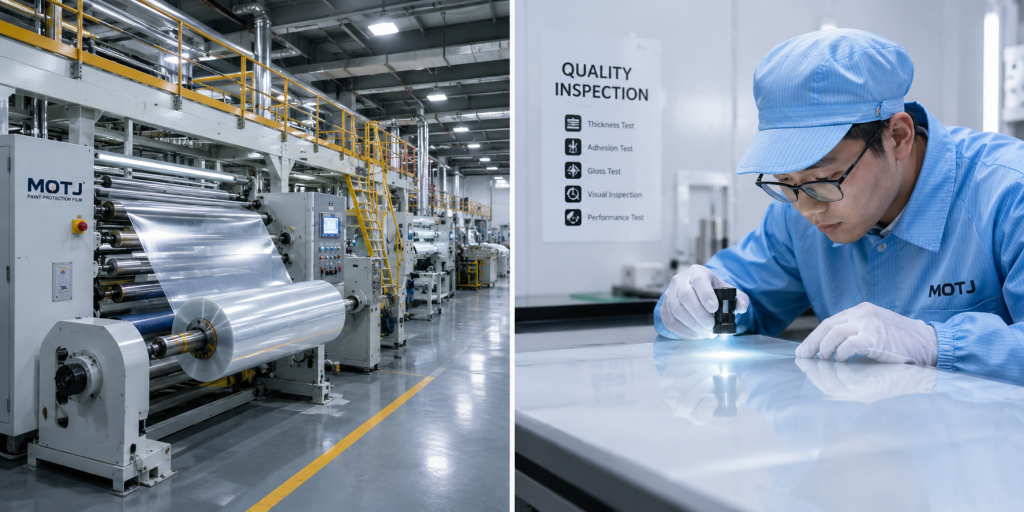
In today’s competitive PPF market, transparency and consistency are often more valuable than the lowest possible price.
Frequently Asked Questions
Is factory-direct PPF cheaper than branded PPF?
In most cases, yes. Factory-direct sourcing removes intermediary markups and can improve distributor margins. However, landed cost, logistics, and support services should also be considered.
What MOQ does MOTJ require for private label orders?
MOQ requirements vary depending on packaging customization, branding requirements, and destination market. Contact our team for current OEM program details.
How long does sample shipping take?
Typical sample delivery times are:
- United States: 3–7 business days
- Europe: 4–8 business days
- Middle East: 5–10 business days
Shipping times may vary based on customs clearance and local courier services.
How can I verify whether a PPF is truly TPU?
Request a Technical Data Sheet, third-party testing reports, and sample material for evaluation. Reputable manufacturers should provide all three.
What certifications should a PPF manufacturer have?
At minimum, distributors should look for ISO 9001 certification and relevant third-party testing documentation such as SGS reports.
What is the most important factor when choosing a PPF supplier?
Consistency. Product performance, installation experience, warranty reliability, and long-term distributor reputation all depend on receiving the same quality in every batch.
 English
  简体中文
简体中文  Español
  Français