
Does TPU Color PPF turn yellow over time? The short answer: Premium aliphatic TPU color PPF does not turn yellow.
While first-generation painted films and inferior aromatic TPU protection layers undergo severe photochemical degradation under ultraviolet (UV) exposure, modern color Paint Protection Film (PPF) engineered with an aliphatic polycaprolactone TPU base and mass-coloration masterbatch pigments resists yellowing, maintaining a color stability delta of Δ E < 1.5 over a 7- to 10-year lifespan.
The Chemistry of Yellowing: Why Inferior PPF Fades and Discolors
Yellowing in protective films is fundamentally a chemical breakdown occurring within the polymer matrix or adhesive layer. Understanding this degradation requires examining molecular structures under solar irradiation.
Aromatic TPU and UV-Induced Quinoid Structure Formation
Lower-tier PPF products frequently utilize aromatic Thermoplastic Polyurethane (TPU) due to lower raw material costs. However, aromatic TPU contains benzene rings within its molecular backbone.
When exposed to solar ultraviolet radiation (specifically UV-A and UV-B spectra between 290 nm and 400 nm:
- UV photons break the carbon-nitrogen and carbon-carbon bonds within the aromatic ring.
- Free radical reactions trigger photo-oxidation, rearranging the benzene structure into conjugated quinoid chromophores.
- These quinoid structures absorb light in the blue spectrum, causing the film to reflect a visible yellow-brown hue.
Aromatic Ring + UV Photons (290–400 nm) ──> Free Radicals ──> Quinoid Chromophores (Yellowing)
Photochemical Degradation in Base Polymers and Adhesives
Even if the topcoat appears durable, yellowing can originate from secondary layers:
- Adhesive Degradation: Pressure-sensitive adhesives (PSAs) formulated with low-grade acrylic polymers cross-link excessively when exposed to heat and UV, oxidizing into yellowed compounds visible through light-colored films.
- Plasticizer Migration: Inferior films rely on monomeric plasticizers to maintain flexibility. Over time, heat causes these small molecules to migrate to the surface, trapping ambient dirt, exhaust particulates, and industrial fallout, which creates a dirty, yellowed film.
Thermal Oxidation vs. Photo-Oxidation Yellowing
Yellowing manifests through two distinct environmental mechanisms:
| Degradation Type | Primary Driver | Chemical Process | Visible Impact |
| Photo-Oxidation | UV-A / UV-B Light | Photolytic cleavage forming chromophore chains | Surface yellowing, loss of gloss, embrittlement |
| Thermal Oxidation | Engine Heat / Ambient Surface Temp (>70℃) | Thermo-oxidative radical reactions in soft segments | Deep-matrix yellowing, adhesive darkening, edge lifting |
Anti-Yellowing Engineering in Premium TPU Color PPF
To eliminate yellowing, high-performance TPU color PPF replaces unstable chemical bonds with UV-inert molecular structures.
Aliphatic TPU: Benzene-Free Molecular Backbone
Premium color PPF uses aliphatic TPU, synthesized using aliphatic diisocyanates (such as Hexamethylene Diisocyanate / HDI or Isophorone Diisocyanate / IPDI).
Because aliphatic TPU contains zero benzene rings, UV photons cannot trigger quinoid chromophore formation. The molecular backbone remains stable under continuous solar exposure, providing intrinsic, permanent resistance to yellowing.
Color Shift (Δ) Control in TPU Color PPF: Combining Aliphatic TPU with UV-Stable Pigments
Achieving total color stability in colored PPF requires matching an aliphatic TPU core with inorganic, non-fading pigments. Total color shift is quantified using the CIELAB color formula:
Where:
- L* represents lightness (black to white)
- a* represents the red/green axis
- b* represents the yellow/blue axis (critical for yellowing tracking)
Top-tier manufacturers maintain Δ E < 1.5 after 3,000+ hours of accelerated weathering testing, a shift imperceptible to the human eye.
Mass-Coloration Masterbatch Fusion vs. Surface Topcoat Dyeing
The manufacturing method directly impacts long-term color retention and anti-yellowing performance:
[ Mass-Coloration Masterbatch ]
├── Pigment fused directly into aliphatic TPU molten resin
├── Uniform color distribution across entire film thickness 、
└── Result: No fading, no layer separation, zero UV-induced color shift
[ Surface Topcoat Dyeing ]
├── Dye applied only to the top protective layer
├── Solvent/UV exposure breaks thin dye layer over time
└── Result: Uneven fading, yellowing under topcoat, patchiness
- Mass-Coloration Masterbatch Fusion: Inorganic pigments are blended directly into the aliphatic TPU resin chips during extrusion. The color is embedded throughout the entire molecular matrix, preventing color migration, bleaching, or yellowing.
- Surface Topcoat Dyeing: Color dyes are applied only within the thin topcoat layer. Sunlight rapidly degrades these superficial dyes, leading to fading, severe yellowing, and topcoat delamination within 12 to 18 months.
International Testing Standards for Yellowing and Color Stability
B2B buyers, distributors, and OEMs rely on standardized laboratory protocols to certify zero-yellowing performance.
ASTM E313 (Yellowness Index / YI Measurement)
ASTM E313 calculates the Yellowness Index (YI) from spectrophotometric data to quantify yellowing in white or transparent polymers:
Where X, Y, and Z are the CIE tristimulus values, and Cx, Cz are coefficients specific to the illuminant (typically D65).
Threshold Values: Defining Unnoticeable Yellowing (Δ YI < 2.0)
- Δ YI < 1.0: Chemically perfect; no humanly visible change.
- Δ YI < 2.0: Industry standard threshold for “Zero-Yellowing” compliance over 10 years.
- Δ YI > 5.0: Severe failure typical of aromatic TPU or non-UV-stabilized films after 500 hours of UV exposure.
CIELAB Color Space and Spectrophotometer Testing (Δ E < 1.5 Standard)
Spectrophotometer testing measures color coordinates under standard illuminants (D65/10°). A rating of Δ E < 1.5 ensures that even bright whites, light greys, and pastel color PPFs exhibit no detectable shade change or yellow drift throughout their service life.
High-Intensity UV Chamber Exposure Tests
Accelerated aging simulates years of real-world solar radiation in controlled laboratory environments:
- ASTM G154 (QUV Accelerated Weathering): Exposes samples to alternating cycles of UV light (0.89 W/m2 at 340 nm) and moisture condensation at elevated temperatures (60℃). Premium aliphatic PPF must pass 3,000 hours without exceeding Δ YI = 2.0.
- SAE J2527 (Performance Standard for Automotive Exterior Materials): Utilizes a Xenon-Arc light source to simulate full solar spectrum exposure, humidity, and water spray.
Cross-Industry Applications Requiring Zero-Yellowing Compliance
The demand for non-yellowing aliphatic TPU color film extends beyond personal vehicles into critical commercial and architectural markets.
Premium OEM Automotive Paint Protection and Color Transformations
Automotive OEMs and aftermarket restylers utilize white, clear, and pastel TPU color PPF to protect factory clear coats while altering vehicle color. Zero-yellowing compliance ensures light-colored wraps retain their original hue without developing unsightly yellow borders around panel gaps.
Architectural Glass and Marble Protection Films
- Marble & Natural Stone Protection: Clear and tinted aliphatic TPU films applied to high-end interior marble countertops prevent acid etching while guaranteeing the stone’s original white veins do not turn yellow under interior lighting.
- Architectural Glazing: Applied to exterior glass facades, non-yellowing TPU maintains high optical clarity and solar heat rejection without darkening or discoloring.
Public Transit Anti-Graffiti & High-End Interior Surface Protection
High-traffic interiors in commercial aircraft, passenger trains, and luxury yachts require durable protection against scratches and chemical cleaners. Aliphatic TPU films pass strict smoke-toxicity and anti-yellowing standards under continuous overhead LED and natural window exposure.
B2B Proofing Tools: How Distributors Can Prove Anti-Yellowing to Dealers
Distributors must provide clear, empirical evidence to demonstrate product quality to installation shops and automotive dealers.
The 72-Hour Accelerated UV Light Box Split Test
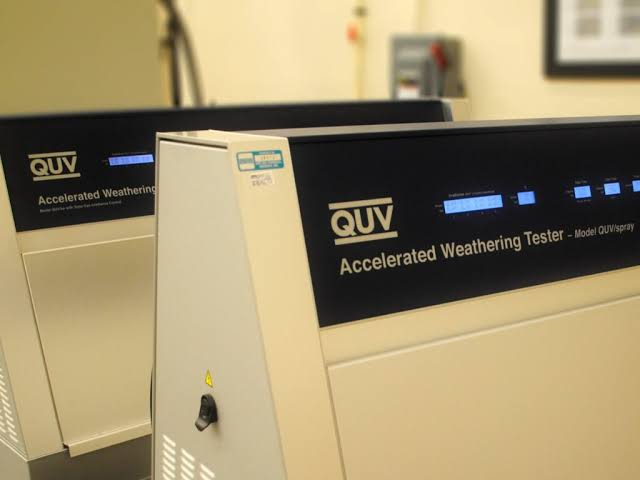
A simple, effective tool for sales demonstrations:
- Mount a sample of premium aliphatic color PPF side-by-side with a competitor’s aromatic sample on a white painted aluminum panel.
- Place the panel in a shortwave UV-C 254 nm or high-intensity UV-A 365 nm exposure chamber.
- Run continuous exposure at 65℃ for 72 hours (equivalent to approximately 2 years of intense outdoor sun).
- Result: Inferior aromatic films turn visibly yellow/brown (Δ YI > 8.0), while aliphatic masterbatch TPU displays no perceptible shift (Δ YI < 1.5).
Using Portable Spectrophotometers for On-Site Color Shift Proofs
Equip field representatives with handheld spectrophotometers (such as X-Rite or Konica Minolta units) to conduct live demonstrations:
- Measure L*a*b* baseline values on dealer test swatches.
- Perform accelerated thermal or UV stress tests in front of the client.
- Take post-test readings to calculate live Δ E and Δ YI values, offering instant proof of product durability.
 English
  简体中文
简体中文  Español
  Français