
TPU Color PPF and PVC Vinyl Wrap may look similar at first glance, but they differ significantly in material composition, durability, installation, and long-term performance.
For automotive restyling professionals and vehicle owners who want to transform a vehicle’s appearance without sacrificing paint protection, choosing the right film material matters. In recent years, the industry has steadily shifted away from traditional PVC vinyl wraps and toward high-performance Thermoplastic Polyurethane (TPU) Color PPF.
This guide provides a detailed technical about TPU Color PPF vs PVC Vinyl Wrap. It explores their material composition, chemical structure, mechanical performance, durability, and installation methods, helping you understand which solution delivers better long-term value.
Key Takeaways
Material Composition: TPU Color PPF is made from advanced aliphatic thermoplastic polyurethane elastomers, while PVC Vinyl Wrap uses polyvinyl chloride combined with plasticizers.
Self-Healing Capabilities: TPU features a polycaprolactone self-healing topcoat that repairs light scratches when exposed to heat or sunlight. PVC offers no self-healing ability and becomes more vulnerable to surface damage over time.
Impact Resistance: Thanks to its exceptional elasticity, TPU absorbs and disperses impact energy, helping protect automotive paint from stone chips. PVC mainly serves as a decorative color layer and provides very limited impact protection.
Lifespan and Durability: Premium TPU Color PPF typically lasts 5–10 years with excellent UV stability. PVC vinyl generally lasts 1–3 years before it begins to fade, shrink, harden, or crack under prolonged outdoor exposure.
Material Science Deep Dive
The biggest performance differences between TPU and PVC begin at the molecular level. Although both materials can change a vehicle’s appearance, their internal structures respond very differently to heat, sunlight, impact, and long-term environmental exposure.
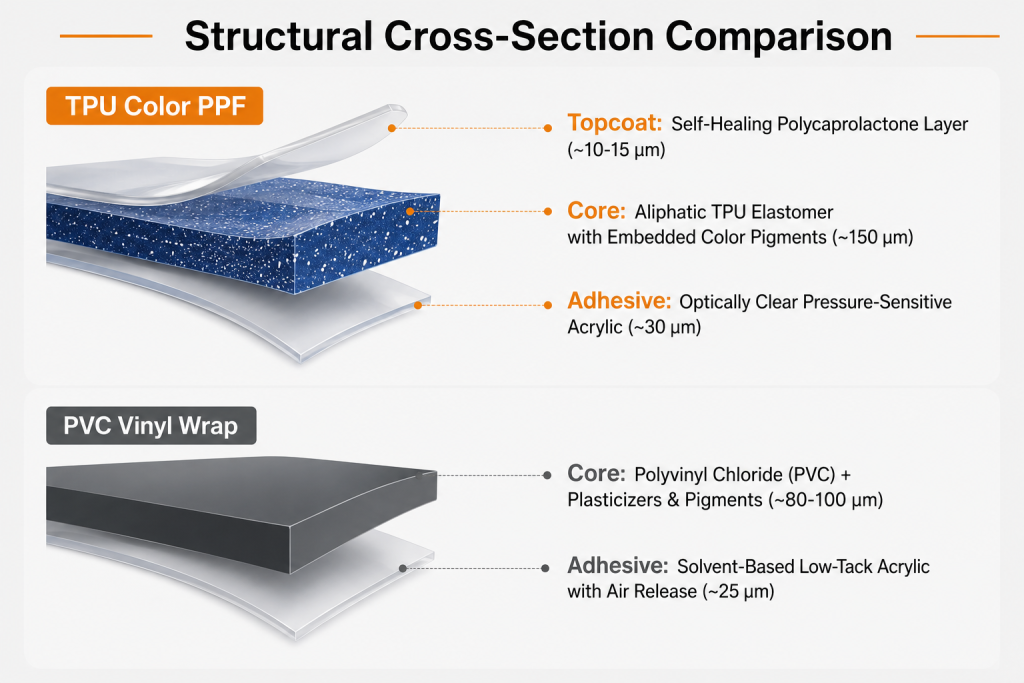
Thermoplastic Polyurethane (TPU Color PPF)
Aliphatic TPU is produced by reacting aliphatic diisocyanates with polyols. Because its molecular backbone contains no aromatic rings, the material absorbs far less ultraviolet radiation that causes yellowing and long-term discoloration.
Its structure combines alternating hard and soft molecular segments. The hard segments provide strength and durability, while the soft segments give TPU its flexibility and remarkable elasticity. Together, they create a phase-separated structure that allows the film to stretch under impact and recover its original shape afterward. This unique behavior is what gives TPU Color PPF its outstanding paint protection performance.
Polyvinyl Chloride (PVC Vinyl Wrap)
PVC is naturally rigid and brittle because of the strong polar attraction between chlorine atoms along its polymer chains. To make PVC flexible enough for vehicle wrapping, manufacturers add plasticizers, such as phthalates or polymeric plasticizers.
These additives increase flexibility by separating the polymer chains and improving molecular mobility. However, they are not chemically bonded to the PVC itself. Over time, heat and UV exposure cause the plasticizers to migrate toward the surface. As they gradually escape, the film becomes harder, shrinks, loses flexibility, and eventually develops cracks. This is one of the primary reasons PVC vinyl has a much shorter service life than TPU Color PPF.
Physical & Mechanical Property Matrix
The laboratory data below highlights the key performance differences between TPU Color PPF and traditional PVC Vinyl Wrap under standardized testing conditions. While both materials can change a vehicle’s appearance, their mechanical properties differ significantly, directly affecting durability, protection, and long-term performance.
| Technical Property | TPU Color PPF | PVC Vinyl Wrap | Test Standard |
|---|---|---|---|
| Total Base Thickness | 150–180 μm | 80–110 μm | ASTM D374 |
| Tensile Strength | 35–50 MPa | 15–25 MPa | ASTM D882 |
| Elongation at Break | 350%–450% | 120%–200% | ASTM D882 |
| Gravel Impact Resistance | Excellent (No Paint Penetration) | Poor (Film Ruptures Instantly) | SAE J400 |
| Gloss Retention (UV Exposure) | >90% after 2,000 Hours | <50% after 1,000 Hours | ASTM G154 |
| Self-Healing Threshold | Active at ≥40°C (Sunlight or Heat) | None | Internal Lab Validation |
Key Performance Comparisons
Impact Dissipation and Puncture Resistance
One of the biggest advantages of TPU Color PPF is its ability to absorb impact. Because the film is nearly twice as thick as conventional PVC Vinyl Wrap, it can disperse kinetic energy far more effectively.
When gravel or road debris strikes a TPU surface, the flexible polymer network compresses and spreads the force across the material. Instead of allowing the impact to concentrate in one spot, TPU cushions the blow and helps protect the factory paint underneath.
PVC Vinyl Wrap behaves very differently. Its thinner structure and limited elasticity provide little impact absorption. Under the same conditions, sharp debris can easily tear through the film and damage the vehicle’s clear coat.
Optical Clarity and Orange Peel Effect
Appearance is another area where TPU stands out.
Traditional PVC wraps often display what’s known as the orange peel effect—a slightly uneven surface texture that distorts reflections. This usually results from limitations in the casting or calendaring process used during manufacturing.
Modern TPU Color PPF uses precision extrusion technology to create a much smoother surface. Combined with a premium polycaprolactone topcoat, it delivers deeper color, sharper reflections, and a finish that closely resembles OEM factory paint. The result is a cleaner, more refined appearance with little to no visible surface distortion.
Chemical Resistance and Environmental Staining
Every day, vehicles face contaminants such as acid rain, bird droppings, tree sap, road salt, and industrial fallout. A high-quality protective film should resist these substances before they leave permanent marks.
Premium TPU Color PPF features a densely cross-linked topcoat that prevents most contaminants from penetrating the film. Dirt and chemicals remain on the surface, making routine cleaning easier while reducing the risk of long-term staining.
PVC Vinyl Wrap has a more porous surface. As it ages, contaminants can penetrate the material and react with migrating plasticizers inside the film. Once staining occurs, polishing usually won’t restore the original appearance without damaging the vinyl itself.
Installation Protocols & Substrate Interfacing
Although TPU Color PPF and PVC Vinyl Wrap may appear similar, their different material properties require completely different installation methods. Using the correct process is essential for achieving proper adhesion, long-term durability, and a high-quality finish.
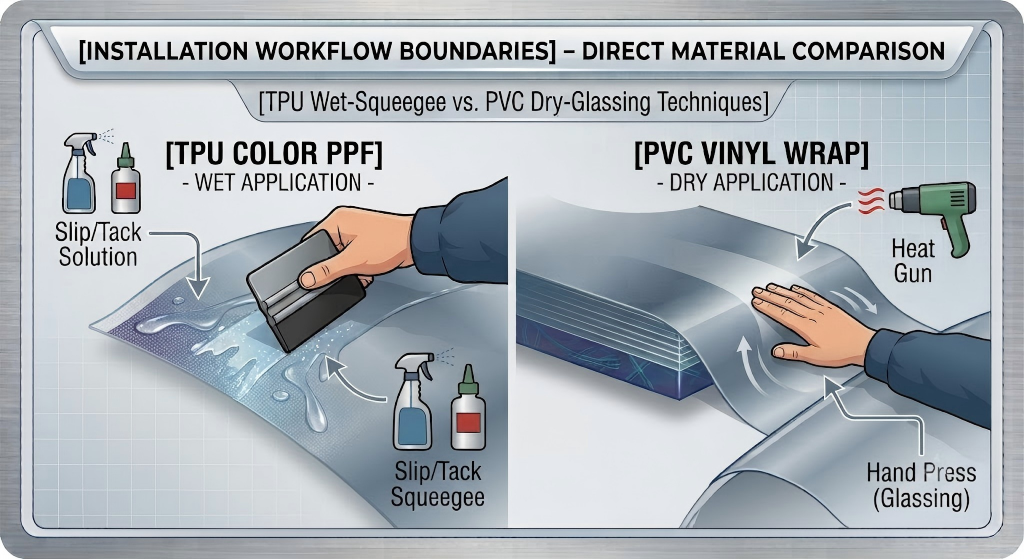
TPU Installation (Wet Process)
Fluid Medium
TPU Color PPF requires a wet installation process. Installers first apply a slip solution—typically purified water mixed with a small amount of baby shampoo or a specialized surfactant. This allows the film to slide smoothly across the paint, making it easier to position accurately before bonding begins.
Adhesive Activation
Once the film is aligned, installers apply a tack solution made from isopropyl alcohol and water around the edges. The solution quickly removes the remaining lubricant and activates the pressure-sensitive acrylic adhesive, creating a secure bond with the vehicle’s surface.
Stretching Capability
TPU offers exceptional elasticity, allowing installers to wrap complex curves and contours without compromising the film’s protective performance. Even so, overstretching should be avoided, as excessive tension may cause pigment separation, commonly referred to as silvering.
PVC Installation (Dry Process)
Air Evacuation
PVC Vinyl Wrap is installed using a dry application method. Its adhesive layer contains microscopic air-release channels that allow trapped air to escape as the installer works the film with a squeegee, helping reduce bubbles during installation.
Thermal Forming
Heat plays a critical role when installing PVC. Installers use a heat gun to raise the material above its glass transition temperature (approximately 80°C), temporarily increasing its flexibility so it can conform to deep curves and recessed areas.
Post-Heating
After installation, PVC must be post-heated to approximately 90–100°C. This step resets the material’s memory and helps prevent shrinkage or edge lifting after the vehicle returns to normal operating temperatures. Skipping this step can significantly reduce the wrap’s long-term stability.
End-of-Life Cycle and Substrate Removal
A film’s performance doesn’t end when its service life is over. Just as important is how easily it can be removed without damaging the vehicle’s original paint. The long-term behavior of the adhesive layer makes a significant difference during removal.
TPU Removability
High-quality TPU Color PPF uses stable, non-yellowing acrylic adhesives designed to resist thermal cross-linking with the factory clear coat. Even after more than five years of continuous UV exposure, the adhesive remains cohesive within the film instead of bonding permanently to the paint.
As a result, installers can usually remove the film in large, continuous sheets with little or no adhesive residue. When applied over healthy OEM paint, premium TPU Color PPF presents virtually no risk of paint delamination during removal.
PVC Removability
PVC Vinyl Wrap behaves differently as it ages. Over time, migrating plasticizers alter the chemical balance of the adhesive layer, causing it to harden and bond more aggressively to both the vinyl and the vehicle’s paint surface.
When removing an older PVC wrap—especially one that has remained on the vehicle for more than three years—the film often becomes brittle and breaks into small pieces. Installers frequently need adhesive removers, plastic scrapers, or steam equipment to complete the job, increasing both labor costs and the risk of damaging the underlying paint.
FAQ
Can TPU Color PPF be polished or ceramic coated like automotive paint?
A: Yes. Premium TPU Color PPF features a polycaprolactone topcoat that can be lightly polished with a fine finishing compound and a dual-action polisher to remove minor oxidation or surface marring. Applying a ceramic coating specifically formulated for PPF can further improve hydrophobic performance, stain resistance, and ease of maintenance without affecting the film’s flexibility.
Why is PVC Vinyl Wrap much cheaper than TPU Color PPF?
A: The price difference comes down to both raw materials and manufacturing processes. PVC is a commodity plastic that manufacturers can produce using relatively simple casting or calendaring methods. TPU, by contrast, requires high-grade aliphatic polyurethane resins, precision extrusion equipment, and multiple coating processes to create its self-healing protective layer. These additional materials and manufacturing steps naturally increase production costs.
Does PVC Vinyl Wrap provide UV protection?
A: Yes, to a certain extent. PVC Vinyl Wrap blocks UV rays from reaching the vehicle’s paint, helping slow down paint fading. However, the vinyl itself absorbs UV radiation. As prolonged exposure causes the material and its plasticizers to degrade, the film gradually becomes brittle and should be removed before it hardens excessively or bonds permanently to the clear coat.
 English
  简体中文
简体中文  Español
  Français