
Paint Protection Film (PPF) has evolved beyond traditional clear protective films into advanced TPU Color PPF systems. As adoption continues to increase worldwide, one key question remains: How long does TPU Color PPF last? The answer depends on the film’s material composition, manufacturing quality, and service environment.
While conventional PVC color wraps typically provide a service life of 1–3 years under demanding environmental conditions, premium TPU Color PPF generally offers 5–10 years of service life. Actual durability depends on several factors, including polymer chemistry, topcoat technology, installation quality, maintenance practices, and regional climate.
For B2B importers and distributors, understanding film longevity is essential. This guide examines the key factors that influence the long-term performance of TPU Color PPF.
The Three Pillars of TPU Color PPF Longevity
When evaluating how long does TPU Color last in commercial deployment, the answer depends directly on three core technical layers: the base polymer chemistry, the pressure-sensitive adhesive (PSA), and the clear/color topcoat system.
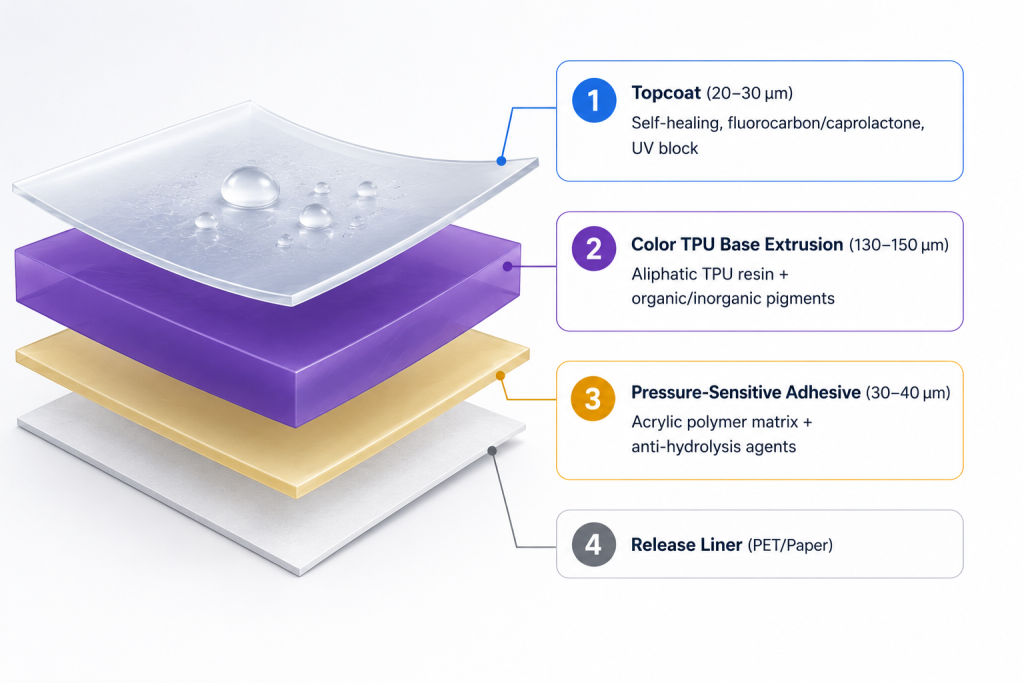
Base Polymer Chemistry: Aliphatic TPU vs. Aromatic/Modified TPU
Aliphatic TPU vs. Aromatic/Modified TPU
Aliphatic TPU: Produced using aliphatic diisocyanates such as HDI or H12MDI. Its molecular structure contains no aromatic benzene rings, giving it excellent resistance to ultraviolet (UV) radiation. As a result, it resists yellowing, embrittlement, and polymer chain scission, even after prolonged outdoor exposure.
Aromatic / Modified TPU: Produced with aromatic diisocyanates such as MDI. Although it offers lower raw material costs and high initial tensile strength, aromatic TPU degrades much faster under prolonged UV exposure. The aromatic rings gradually undergo photo-oxidation, leading to yellowing, color shift, and premature cracking over time.
When evaluating long-term weatherability, base material chemistry plays a decisive role—which is why understanding [how TPU outlasts traditional PVC vinyl wraps in durability] helps distributors select the right product line for harsh climates.
Pressure-Sensitive Adhesive (PSA) Hydrolysis & Delamination Resistance
The acrylic-based PSA layer bonds the TPU film securely to the vehicle’s clear coat. High-quality PSA formulations use cross-linked acrylic polymers combined with hydrophobic additives to improve long-term adhesion and moisture resistance.
Lower-grade adhesives are more susceptible to hydrolysis—a chemical breakdown triggered by moisture penetrating the film—which can result in bubbling, edge lifting, adhesive transfer during removal, or even complete delamination.
Topcoat Weatherability and Cross-Linking Density
The topcoat, typically 20–30 μm thick, acts as the first line of defense against chemical attack, environmental contamination, and everyday surface scratches.
- Caprolactone-Based Topcoats: Create a dense cross-linked network with self-healing properties that activate under moderate heat, such as hot water or direct sunlight.
- Fluorocarbon/Ceramic-Modified Topcoats: A higher cross-linking density improves hydrophobic performance, producing water contact angles greater than 105° while lowering surface energy. This helps prevent acid rain, bug residue, and road tar from reaching the color layer beneath.
Environmental Stressors and Regional Degradation Rates
Film lifespan varies significantly depending on the installation environment and local climate conditions.
| Climate Zone | Representative Regions | Primary Stress Factor | Expected Lifespan (Aliphatic TPU) | Failure Mode |
|---|---|---|---|---|
| High UV / Arid | Middle East, Arizona, Australia | Solar Radiation (>2000kWh/㎡/year) | 3–5 Years | Gloss loss, pigment fading, topcoat oxidation |
| Extreme Thermal Cycling | Kazakhstan, Northern Europe, Canada | Temperature Range (-40℃ to +40 ℃) | 5–7 Years | Thermal expansion stress, micro-cracking, edge lifting |
| Coastal / Industrial | Gulf Coast, Southeast Asia, Port Cities | Salt Fog, High Humidity (>80%), Acid Rain | 5–7 Years | PSA hydrolysis, chemical staining, edge contamination |
High UV Radiation Index (Middle East, California, Australia)
Prolonged exposure to UV-A and UV-B radiation accelerates photo-oxidation in lower-grade pigments. In high-UV regions, aliphatic TPU resins should be paired with Hindered Amine Light Stabilizers (HALS) and UV absorbers distributed throughout both the topcoat and the TPU base layer.
Thermal Cycling & Extreme Cold (Kazakhstan, Northern Europe, Canada)
Repeated freeze-thaw cycles place continuous stress on both the film and its adhesive system. TPU materials with insufficient low-temperature flexibility become brittle in cold conditions, increasing the risk of impact damage from gravel and road debris. High-quality aliphatic TPU retains its rubber-like flexibility at temperatures as low as -40°C.
Coastal Salt Fog and Industrial Chemical Pollution
Salt-laden air, vehicle emissions (SOx/NOx), and industrial fallout create a highly corrosive environment for automotive surfaces. Without a chemically resistant topcoat, acidic contaminants gradually penetrate the film surface, leading to discoloration, spotting, and accelerated topcoat degradation.
How Long Does TPU Color PPF Last? Accelerated Testing & Lifespan Standards
To determine how long TPU Color PPF lasts, manufacturers rely on standardized accelerated weathering tests instead of waiting years for real-world field exposure.
ASTM G154 / ISO 4892-3 (QUV Accelerated Weathering Test)
The QUV test combines fluorescent UV lamps with controlled moisture-condensation cycles to simulate years of outdoor weathering in a laboratory environment.
Interpreting 2000-Hour vs. 3000-Hour QUV Test Certificates
- 2000-Hour QUV Pass: Generally represents approximately 3–5 years of outdoor exposure under temperate climate conditions.
- 3000-Hour QUV Pass: Generally represents approximately 7–10 years of outdoor exposure. To meet this level, the film should maintain a color difference of ΔE < 2.0, retain more than 85% of its original gloss, and remain free of surface cracking or micro-fissures.
ASTM D3170 / SAE J1960 (Xenon Arc Light Weathering)
Xenon arc testing reproduces the full solar spectrum, including ultraviolet, visible, and infrared radiation, together with periodic water-spray cycles. The test evaluates color stability, gloss retention, and pigment durability under conditions that closely resemble natural sunlight.
85°C / 85% RH Damp Heat Testing for PSA Stability
Samples are placed in an environmental chamber at 85°C and 85% relative humidity for 1,000 continuous hours. This test evaluates the adhesive’s resistance to hydrolysis, helping verify that it maintains peel strength without yellowing or becoming brittle over time.
Product Line Tiering Based on Lifespan Parameters
Structuring product offerings around how long does TPU color PPF last allows importers and brand owners to align resin types, pigment selection, and warranty expectations across different market segments.
Entry-Level Lines (1–3 Year Lifespan) vs. Premium Fleet/OEM Lines (5–10 Year Warranty)
- Entry-Level / Promotional Grade (1–3 Years): Built on aromatic or hybrid TPU base resins with standard acrylic adhesives. Best suited for temporary color changes or promotional fleet wraps where extended UV durability is not essential.
- Mid-Tier Commercial Grade (3–5 Years): Uses standard aliphatic TPU with conventional caprolactone topcoats. Suitable for regions with moderate UV exposure.
- Premium / OEM Grade (5–10 Years): Manufactured with high-quality aliphatic TPU resin (such as Covestro or Lubrizol), high-lightfastness inorganic pigments, nano-ceramic fluorocarbon topcoats, and anti-hydrolysis acrylic adhesives. Typically certified to 3000-hour QUV and relevant ASTM standards.
Expanding into High-Durability Non-Automotive Lines
The durability of TPU color films also supports applications beyond passenger vehicles.
- Marine TPU Films (ASTM B117 Salt Spray Certified): Formulated to withstand continuous salt spray, diesel fumes, and harsh reflected sunlight without peeling or yellowing.
- Architectural Facade & Outdoor Solar Equipment Protection: Suitable for exterior panels, signage, and equipment enclosures where long-term color retention and impact resistance are required.
Risk Management for B2B Importers: Structuring Realistic Warranties
Warranty claims can severely damage margins if product specifications do not match local climate conditions or if expectations around how long does TPU Color last are miscommunicated.
How to Match Film Grade to Local Climate Zones to Prevent Mass Claims
- Climate Mapping: Avoid distributing entry-level or modified TPU films in high-UV regions (e.g., GCC countries, Arizona, and Australia) under multi-year warranty programs. Instead, specify certified 3000-hour QUV-tested 100% aliphatic TPU films for these markets to ensure long-term durability.
- Clear Warranty Exclusions: Warranty exclusions should clearly cover damage resulting from improper chemical cleaning (pH < 3 or pH > 11), pressure washer nozzle distances below 30 cm, and pre-existing paint defects prior to installation.
- Prorated Warranty Structures: Consider implementing a prorated warranty model for 5–10 year product lines (e.g., 100% replacement coverage during years 1–3, gradually decreasing to 20% by year 7 and beyond) to better manage long-term warranty liability.
Essential Installation and Care Guidelines to Preserve Film Lifespan
- Pre-Installation Preparation: Ensure the vehicle surface is thoroughly decontaminated and completely free of polishing oils, wax residues, and other contaminants before installation.
- Edge Wrapping & Tension Management: Avoid stretching TPU Color PPF beyond 15–20% during installation, as excessive tension may lead to pigment distortion, adhesive stress, and premature edge lifting.
- Post-Care Maintenance: Recommend PPF-compatible ceramic coatings and advise against aggressive solvent-based cleaners or petroleum-based waxes to help preserve the topcoat and simplify long-term maintenance.
FAQ
How long does TPU color PPF last compared to traditional PVC color vinyl wrap?
Standard PVC color vinyl wraps typically last 1 to 3 years before showing signs of cracking, fading, or adhesive transfer. Premium TPU color PPF lasts 5 to 10 years because aliphatic TPU resists UV degradation, maintains elasticity, and incorporates protective self-healing topcoats.
Does TPU Color PPF fade over time in direct sunlight?
Premium TPU Color PPF incorporates high-lightfastness inorganic pigments embedded within an aliphatic TPU matrix, helping maintain excellent color stability under prolonged UV exposure. Under standardized weathering conditions, high-quality films can maintain a color difference of ΔE < 2.0, whereas lower-grade films formulated with organic dyes or aromatic resins generally exhibit faster fading, yellowing, and color shift.
Can TPU Color PPF be ceramic coated to extend its lifespan?
Yes. Although a ceramic coating does not determine how long TPU Color PPF lasts, it helps maintain the film’s appearance and protective performance over time. A PPF-specific ceramic coating creates an additional sacrificial protective layer that reduces chemical etching caused by bird droppings, acid rain, tree sap, and hard water deposits, while helping preserve the topcoat and simplify routine maintenance.
 English
  简体中文
简体中文  Español
  Français