
For automotive paint protection film (PPF) distributors, foreign trade importers, and brand managers, “self-healing” is often introduced as a simple selling point: apply heat to a scratched surface and watch the mark disappear. However, real-world performance depends on much more than a visual demonstration.
Across different operating environments—from temperature fluctuations in Kazakhstan to acid rain exposure in tropical regions and repeated friction on commercial fleets—the polymer structure behind the film determines whether the surface maintains its optical clarity or eventually develops performance issues.
Understanding the molecular mechanism, testing methods, and practical limitations of self-healing thermoplastic polyurethane (TPU) films helps B2B buyers evaluate technical specifications, reduce warranty risks, and create more reliable product demonstrations for installers, detailers, and fleet customers.
Key Takeaways
Hydrogen Bonding & Shape Memory:
Self-healing performance comes from the dynamic interaction of polymer chains, including reversible hydrogen bonding and the elastic recovery behavior of thermoplastic polyurethane.
Instant vs. Heat-Assisted Healing:
Factors such as topcoat formulation, glass transition temperature ($T_g$), and polymer network structure determine whether a film can recover at room temperature or requires additional heat activation (typically 60°C–80°C).
Laboratory Verification:
Self-healing performance should be evaluated through standardized testing methods, including scratch resistance analysis, surface recovery measurement, and optical performance evaluation.
Performance Limitations:
Excessive stretching during installation and long-term chemical contamination of the topcoat are two common factors that may reduce self-healing capability and increase warranty risks.
Understanding the Chemistry: How TPU Self-Healing Works at a Molecular Leve
Self-healing PPF is not created by applying a temporary surface treatment or a simple protective coating. Its recovery ability comes from the specially designed molecular structure of multi-layer aliphatic thermoplastic polyurethane (TPU).
The TPU system combines flexibility, elasticity, and surface recovery characteristics through carefully balanced polymer segments and topcoat formulations.
Hydrogen Bonding and Polymer Shape Memory Effect
At the molecular level, aliphatic TPU is composed of alternating hard segments and soft segments, each contributing different performance characteristics.
Hard Segments:
These segments are typically formed through reactions between aliphatic diisocyanates and short-chain diols. They provide structural strength, dimensional stability, and physical reinforcement within the polymer network.
Soft Segments:
These segments are commonly based on long-chain polyether or polycaprolactone polyols. They provide flexibility, elasticity, and the molecular mobility required for surface recovery.
When a sharp object—such as road debris, a brush, or a washing tool—creates a scratch on the PPF surface, it does not always remove material completely. Instead, the polymer chains are mainly displaced and temporarily forced away from their original position.
During this process, secondary interactions between polymer chains, including hydrogen bonding, are disturbed. At the same time, the elastic structure of the TPU stores deformation energy, creating a driving force that helps the surface recover when suitable conditions are provided.
Because hydrogen bonds are reversible interactions, they can repeatedly break and reform without damaging the main covalent polymer backbone.
The Microscopic Mechanism of Scratches and Thermal Reflow
At the microscopic level, a scratch creates a deformation zone rather than simply cutting through the material. Polymer chains around the damaged area become displaced, creating a groove with compressed and stretched regions around the scratch.
When sufficient thermal energy is applied, polymer mobility increases. The material begins to reorganize, allowing the displaced chains to move closer to their original arrangement.
The recovery process can be understood through three stages:
The recovery process can be understood through three stages:
- Mechanical Scratching
Before Recovery:
__ ————————- Scratch Groove
Displaced polymer chains store elastic strain energy. The scratch creates localized deformation within the topcoat. The polymer structure stores mechanical energy during this process. - Thermal Activation (Thermal Reflow)
Heat Activation:temperature increase polymer mobility.
T > Tg
When the temperature rises above the material’s effective glass transition range (Tg), polymer segments become more mobile. This allows the surface structure to rearrange. - Polymer Recovery and Surface Restoration
After Recovery:
Smooth optical surface
The stored elastic energy helps restore the surface profile while polymer interactions gradually reform.
The recovery process mainly depends on three factors:
Energy Storage: Elastic TPU segments retain deformation energy and provide the driving force for surface recovery.
Thermal Activation: Heat increases molecular movement by reducing the resistance to polymer chain rearrangement.
Surface Re-alignment: Displaced polymer chains move toward a lower-energy state, restoring a smoother surface structure.
Topcoat vs. Base Material: Instant Healing vs. Heat-Assisted Healing
Not all self-healing films behave in the same way. The recovery speed and scratch depth capability depend largely on the formulation of the topcoat layer and whether the deformation remains within the surface coating or reaches the TPU substrate.
In many PPF structures, self-healing primarily occurs within the elastomeric topcoat layer (approximately 10–12 µm), while deeper damage may involve the underlying TPU base layer (approximately 130–150 µm).
| Feature | Instant (Ambient) Healing Topcoat | Heat-Assisted Healing Topcoat |
|---|---|---|
| Glass Transition Temperature (Tg) | Lower Tg range (approximately 0°C–15°C) | Higher activation range (approximately 40°C–65°C) |
| Activation Source | Normal ambient conditions (around 20°C–25°C) | External heat sources such as hot water, sunlight, or heat guns |
| Topcoat Hardness | Softer structure with higher flexibility | Harder structure with improved chemical resistance |
| Chemical Resistance | Balanced protection with higher surface mobility | Stronger resistance against oils, chemicals, and environmental contamination |
| Healing Depth Capability | Mainly fine surface scratches (<5 µm) | Deeper micro-scratches (up to approximately 10–12 µm depending on formulation) |
Balancing Topcoat Hardness and Elasticity to Prevent Performance Loss
Developing a self-healing topcoat requires balancing two competing properties: surface hardness and polymer mobility.
A softer topcoat can recover quickly because polymer chains move more easily. However, excessive softness may increase the risk of chemical swelling, contamination retention, or surface marking under harsh environments.
On the other hand, a highly rigid topcoat provides stronger resistance against chemicals, abrasion, and environmental exposure. However, increased cross-link density can reduce polymer mobility and require higher temperatures to activate recovery.
Therefore, self-healing performance is always a balance between flexibility and durability.
The ideal formulation depends on the intended application environment, climate conditions, and expected usage scenarios.
Industry Testing Standards & Lab Verification Methods
To evaluate self-healing performance accurately, technical buyers should look beyond visual demonstrations and request standardized test data. A scratch disappearing under a heat gun can be impressive, but laboratory testing provides a more objective understanding of surface durability, recovery capability, and long-term performance.
A complete evaluation should consider both the film’s initial resistance to damage and its ability to recover after mechanical stress.
Quantitative Measurement of Self-Healing Performance
Measuring self-healing performance requires more than observing whether a scratch disappears visually. A reliable evaluation should analyze:
- The depth and severity of the scratch
- The recovery percentage after heat activation
- Changes in gloss and optical clarity after repeated damage cycles
- Whether the polymer structure maintains recovery ability over time
Different testing methods focus on different aspects of film performance.
ASTM D3363 (Pencil Hardness Test) for Topcoat Scratch Resistance
ASTM D3363 is commonly used to evaluate the surface hardness of coatings and films. The test uses calibrated pencils with different hardness levels, ranging from soft graphite grades such as 6B to harder grades such as 9H.
During testing, the pencil is applied at a 45-degree angle under a controlled load to determine the level at which the surface begins to show visible damage.
For high-performance aliphatic TPU films:
- Typical surface hardness performance may range from F to 2H, depending on the topcoat formulation.
- After surface scratching, thermal activation can be applied to evaluate whether visible marks are reduced or eliminated.
However, pencil hardness alone does not fully represent self-healing capability. It mainly measures scratch resistance, while recovery performance requires additional surface analysis.
ASTM D2197 (Scratch Adhesion and Surface Damage Evaluation)
ASTM D2197 is designed to evaluate the resistance of coatings to mechanical scratching using controlled loads. When applied as part of self-healing research, it can help create repeatable scratch conditions for analyzing recovery behavior.
A typical evaluation process includes:
- Initial Scratch Measurement
A surface measurement system, such as a profilometer, records the original scratch depth ($D_0$).
Typical evaluation ranges may involve controlled scratches around several micrometers deep, depending on the test setup. - Thermal Activation
Heat is applied under controlled conditions, such as:
- Warm water exposure
- Heated air
- Infrared radiation
The purpose is to activate polymer chain movement and encourage surface recovery.
- Post-Healing Measurement
The remaining scratch depth ($D_r$) is measured after recovery. - Healing Efficiency Calculation
The recovery ratio can be expressed using:
$$
HE(\%) = \left(\frac{D_0-D_r}{D_0}\right) \times 100
$$
Where:
- $D_0$ = Original scratch depth before healing
- $D_r$ = Remaining scratch depth after healing
- $HE$ = Healing efficiency percentage
A higher recovery percentage indicates stronger surface restoration under the specific testing conditions.
However, self-healing results should always be interpreted together with test temperature, scratch depth, loading force, and measurement method. Different testing conditions can produce significantly different results.
Repeated Scratch Endurance and Coating Fatigue Tests
A self-healing surface is expected to recover repeatedly during normal vehicle use. Therefore, evaluating long-term durability requires more than a single scratch-and-recovery test.
Repeated abrasion testing helps determine whether the polymer network can maintain its recovery ability after multiple damage cycles.
A typical evaluation process may include:
- Applying repeated abrasion using materials such as steel wool pads or standardized brushes
- Controlling the applied pressure and number of cycles
- Applying heat activation at fixed intervals
- Measuring changes in gloss and surface appearance afterward
Example evaluation conditions:
- Abrasion cycles: 100–500 cycles
- Applied load: approximately 500 g
- Heat activation: around 70°C at scheduled intervals
- Optical evaluation: gloss measurement at 60° angle according to ASTM D523
A durable self-healing system should maintain high optical performance and avoid permanent surface damage caused by polymer fatigue, contamination, or degradation of the topcoat structure.
Spec Thresholds & Application Segmentation: From Automotive to Special Applications
Self-healing performance requirements are not identical for every market. Climate, vehicle usage, installation conditions, and customer expectations all influence the ideal TPU film formulation.
A film designed for cold northern regions may require different recovery characteristics compared with one used in hot desert environments.
Healing Activation Temperature vs. Regional Climate Adaptability
Selecting the appropriate self-healing system requires understanding how environmental temperature affects polymer behavior.
Cold / Nordic / Central Asian Climates
(Examples: Kazakhstan, Northern Europe)
In colder regions, outdoor temperatures may frequently fall below freezing. Lower temperatures reduce polymer chain mobility, which can slow down surface recovery.
Recommended characteristics:
- Lower-$T_g$ formulations with easier activation
- Improved low-temperature flexibility
- Recovery ability through mild heat sources such as sunlight or warm water washing
For these environments, films with lower activation requirements may provide more consistent daily performance because the polymer can regain mobility even under limited thermal conditions.
Hot / Arid / Tropical Climates
(Examples: Middle East, Southeast Asia)
Vehicles operating in hot climates experience significantly higher surface temperatures. Under direct sunlight, painted surfaces can reach approximately 65°C–80°C.
In these conditions, the topcoat must maintain a balance between mobility and resistance.
Recommended characteristics:
- Stronger thermal stability
- Higher chemical resistance
- Better resistance against oils, pollutants, and organic contamination
A very soft instant-healing topcoat may become overly mobile under extreme heat, increasing the possibility of dirt adhesion, contamination retention, or surface marking.
Hardness vs. Healing Balance Across Different Applications
Different industries require different combinations of flexibility, hardness, optical performance, and recovery speed.
Automotive Clear TPU PPF vs. TPU Color PPF
Clear TPU PPF
Clear paint protection film focuses heavily on optical performance.
Key requirements include:
- High transparency
- Low haze
- Strong gloss retention
- Balanced scratch recovery
Because the purpose of clear PPF is to protect the original paint finish, maintaining visual clarity is one of the most important performance factors.
TPU Color PPF
TPU Color PPF combines paint protection functionality with color transformation. Compared with traditional vinyl wraps, it requires a different balance between appearance and surface durability.
The film structure may include pigments, metallic effects, or special visual finishes within the TPU layer or coating system.
The topcoat must maintain:
- Color depth
- Surface gloss or matte appearance
- Scratch resistance
- Self-healing performance
This is especially important for dark colors, satin finishes, and high-gloss surfaces where fine swirl marks are easier to notice.
High-Touch Commercial Surfaces
Self-healing TPU technology is also applied beyond exterior automotive surfaces.
Applications may include:
- Automotive interior panels
- Touch interfaces
- Commercial displays
- Protective films for frequently handled surfaces
These applications typically prioritize:
- Low-temperature recovery
- Resistance against fingerprints
- Smooth surface feel
- Protection against repeated contact damage
For these uses, surface comfort and daily recovery speed may become more important than extreme chemical resistance.
How B2B Buyers Can Demonstrate Self-Healing to End Customers
For detail shop owners, distributors, and sales representatives, visual demonstrations are one of the most effective ways to explain self-healing technology. A controlled demonstration allows customers to directly observe the relationship between mechanical damage, thermal activation, and surface recovery.
However, a demonstration should be designed carefully. The goal is to show the actual capability of the material rather than create unrealistic expectations.
A repeatable test method helps customers better understand how TPU PPF responds under controlled conditions.
Live showroom demonstration process
Steel Wire Brush / Brass Scratch Tool → Apply Controlled Micro-Scratch Pattern → Heat Gun / Infrared Heat Lamp (60–70°C) → Activate Polymer Mobility and Surface Recovery → Optical Inspection / Gloss Measurement → Evaluate Surface Restoration
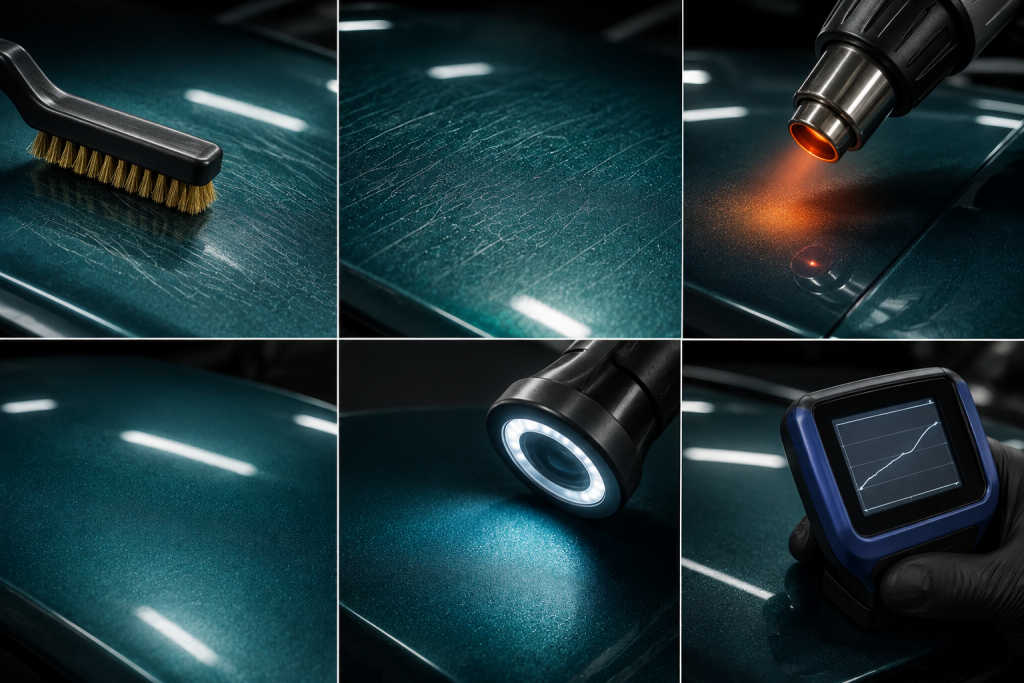
The Wire Brush & Heat Gun Live Demonstration
This demonstration is commonly used because it provides immediate visual feedback.
A basic procedure includes the following steps:
1. Sample Preparation
Mount a self-healing TPU PPF sample onto a dark painted metal panel or test board.
A darker background makes surface scratches easier to observe and allows customers to clearly compare the surface before and after recovery.
2. Controlled Scratching
Use a controlled scratching tool, such as:
- Soft brass wire brush
- Fine steel wool
- Standardized abrasion material
Apply consistent pressure to create visible surface marks.
Important: Avoid using extremely sharp tools that completely cut through the topcoat and damage the underlying TPU layer. Once the polymer structure is physically severed, the material may not be able to restore the original surface condition through normal self-healing mechanisms.
Self-healing is designed mainly for surface-level deformation and micro-scratches, not deep cuts or material removal.
3. Thermal Activation
Apply controlled heat using:
- Heat gun
- Infrared lamp
- Warm water
Typical demonstration temperatures are around 60°C–75°C, depending on the film formulation.
The heat increases polymer mobility and allows the surface structure to begin recovering.
4. Surface Observation
After heat activation, the scratched area can be visually inspected.
Under suitable conditions, fine surface marks gradually become less visible as the topcoat reorganizes and returns toward a smoother surface profile.
For professional evaluation, optical tools such as gloss meters or surface measurement equipment can provide additional quantitative data.
Heat Lamp Demo Stands for Automotive Detail Shops
For retail detailing studios and training centers, a permanent demonstration display can help customers understand self-healing technology during consultations.
A typical setup includes:
Display Structure
A comparison panel containing:
- Self-healing TPU PPF sample
- Conventional non-self-healing material as a reference
The comparison allows customers to observe how different materials respond under the same conditions.
Demonstration Process
- Create similar surface scratches on both materials.
- Apply infrared heating for a controlled period.
- Compare the surface recovery results.
The purpose of the display is not only to show that scratches disappear, but also to explain why polymer structure affects material performance.
Common Self-Healing Failures and How to Avoid Performance Issues
Self-healing technology has clear performance boundaries. It does not mean a film can recover from every type of damage under every environmental condition.
Understanding these limitations helps distributors, installers, and end users establish realistic expectations and reduce unnecessary warranty disputes.
Important: Self-healing performance depends on polymer formulation, installation quality, environmental exposure, and maintenance conditions. Overstating the capability of a film can lead to incorrect expectations and avoidable customer complaints.
Topcoat Contamination and Acid Rain Etching
Although heat activation improves polymer mobility, it can also make the surface more sensitive to certain contaminants when the material is in a highly active state.
Mechanism
When a vehicle is exposed to strong sunlight, exterior surfaces such as the hood may reach temperatures around 70°C.
At elevated temperatures:
- Polymer chains become more mobile.
- The topcoat becomes more flexible.
- Contaminants remaining on the surface may interact more strongly with the coating.
Common contaminants include:
- Acidic rain deposits
- Bird droppings
- Insect residue
- Industrial pollutants
If these substances remain on the surface for extended periods, they may cause chemical staining, etching, or permanent marks.
Failure Mode
After cooling, contaminants may leave behind:
- Discoloration
- Etching patterns
- Surface irregularities
- Reduced optical clarity
These issues are chemical damage rather than mechanical scratches, meaning normal self-healing mechanisms cannot fully restore the original appearance.
Prevention and Maintenance
Proper maintenance helps reduce contamination-related damage:
- Wash the vehicle regularly, especially after exposure to insects, bird droppings, or industrial pollution.
- Use maintenance products designed for PPF-compatible surfaces.
- Avoid aggressive chemicals that may affect the topcoat structure.
Hydrophobic coatings or compatible protective treatments may also help reduce contaminant adhesion and improve surface maintenance.
Over-Stretching During Installation and Thermal Memory Loss
Installation quality plays an important role in maintaining self-healing performance.
Although TPU films are highly flexible, excessive stretching can affect the balance between the topcoat and the underlying TPU layer.
Normal TPU Film Structure
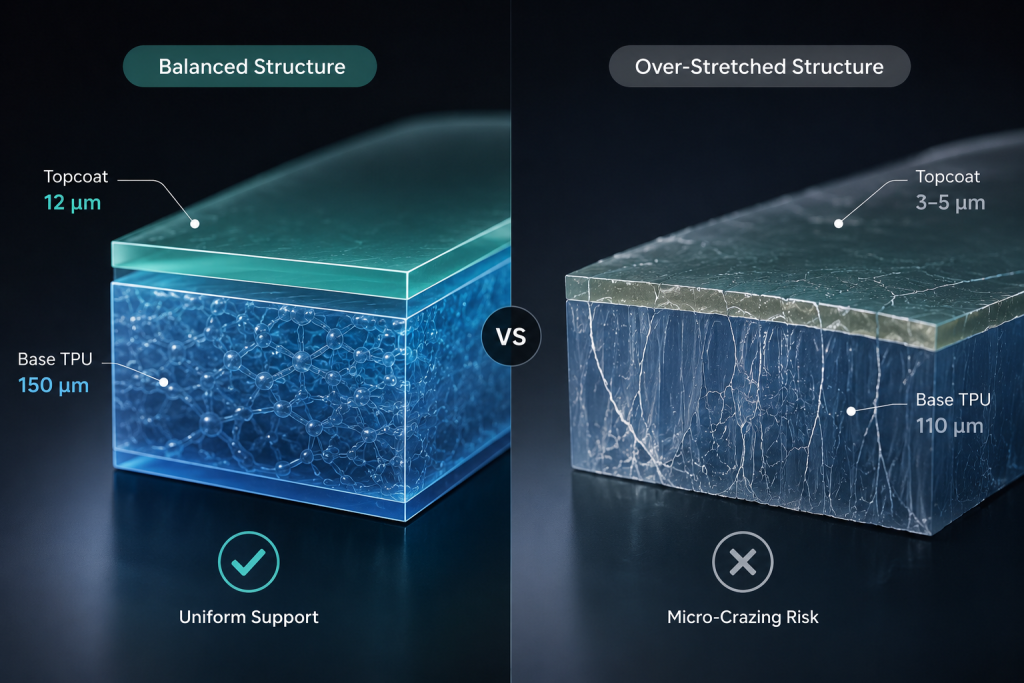
Mechanism
The topcoat and TPU substrate do not always stretch at the same rate.
The surface layer is engineered mainly for:
- Scratch resistance
- Chemical protection
- Optical performance
- Self-healing behavior
The TPU base layer provides:
- Elasticity
- Stretchability
- Structural support
When installers apply excessive tension—especially around complex curves such as bumpers, mirrors, and sharp body edges—the topcoat may become thinner or develop microscopic stress areas.
Failure Mode
Excessive stretching may result in:
- Reduced local healing capability
- Loss of surface uniformity
- Micro-cracking
- Possible separation between coating layers
These problems are usually localized around high-stress installation areas.
Prevention for Installers and Distributors
To maintain film performance:
- Follow recommended installation stretching limits.
- Avoid forcing the material into extreme shapes through excessive tension.
- Use controlled heat or steam when necessary to relax the film during installation.
- Train installers to balance stretching force with material recovery behavior.
A well-installed TPU PPF system allows the topcoat, adhesive, and TPU substrate to work together as designed.
Final Note
Self-healing technology is not simply a visual effect. It represents the interaction between polymer chemistry, material design, environmental conditions, and installation practice.
A better understanding of these factors allows technical buyers to evaluate performance more accurately, communicate realistic expectations, and make better decisions when selecting TPU PPF technologies.
 English
  简体中文
简体中文  Español
  Français